
Victorian home interiors represent more than just a design aesthetic, they’re a time capsule of 19th-century craftsmanship, taste, and aspiration. During Queen Victoria’s reign from 1837 to 1901, homeowners filled their rooms with layered ornament, rich colors, and carefully curated collections that signaled education and worldly experience. Today, reviving victorian house interior design in your home doesn’t mean recreating a museum. Instead, it’s about understanding the principles behind that era’s distinctive layering and ornamentation, then adapting them for modern comfort and function. Whether you’re restoring original details or adding Victorian touches to a contemporary space, this guide walks you through the core design elements, color strategies, and practical steps to capture that timeless, sophisticated character.
Table of Contents
ToggleKey Takeaways
- Victorian home interior design emphasizes layered ornamentation, deep saturated colors, and deliberate curation of objects that reflect taste and refinement, not clutter.
- The tripartite wall treatment—dividing walls into wainscot, main field, and decorative frieze—is a signature feature of authentic Victorian interiors that adds visual richness and depth.
- Modern Victorian interiors succeed by selecting one or two authentic focal pieces (like a period settee or marble mantelpiece) and blending them with contemporary furniture that offers durability and comfort.
- Period-appropriate lighting with Edison-style bulbs, crystal fixtures, and gas light sconces combined with layered textiles creates authentic character while supporting modern efficiency.
- Strategic compromises like retaining original architectural details while adding rear extensions and open-plan kitchens allow homeowners to honor Victorian aesthetics without sacrificing livability.
- Editing and intentionality transform Victorian home interior spaces: display one or two accessory categories rather than overwhelming surfaces, ensuring functional, comfortable homes that reflect personal taste.
Defining Victorian Style: History and Core Design Principles
Victorian style draws from an eclectic revival of historical influences, Gothic, Rococo, Renaissance, layered with Asian and Middle Eastern motifs. The result is ornate, orderly, and deliberately “busy” in a way that reflected wealth and refinement during the era.
Victorian homes featured clear spatial hierarchies. Public rooms (parlors, dining rooms) were separated from private spaces, with many smaller, specialized rooms rather than today’s open-plan layouts. A typical Victorian home had a formal parlor for entertaining, a morning room for family, a library, and distinct serving areas.
The defining principle was that “bare” rooms were poor taste. Every surface, walls, mantels, tables, even windowsills, displayed objects: books, figurines, clocks, framed photographs, and collected treasures. This wasn’t clutter: it was deliberate curation that communicated status, education, and refined taste. Understanding this philosophy is key to designing authentic victorian house interior spaces. Rather than fighting this instinct, modern Victorian interiors embrace layered decoration while keeping layouts functional for how people actually live now.
Essential Color Palettes and Wall Treatments
Victorian rooms favored deep, saturated colors that created intimate, jewel-like spaces. Common palette choices included burgundy, forest green, dark navy, deep red, and somber grays, particularly in hallways and entry areas.
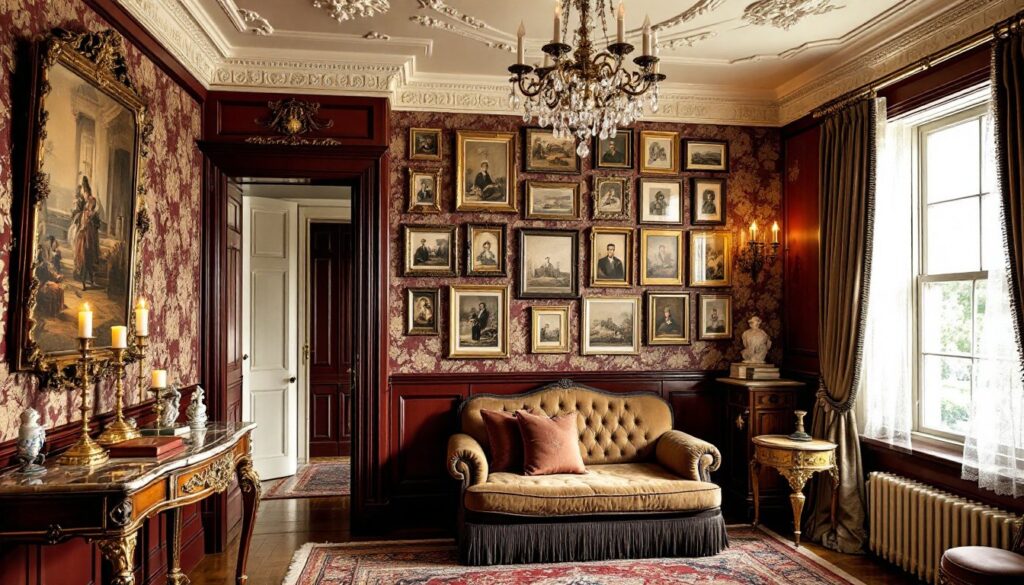
One of the most distinctive victorian house interior design features is the tripartite wall treatment. This divides the wall into three zones: a wainscot or dado (typically painted wood paneling or wallpaper in a solid color or subtle pattern) running 3 to 4 feet high, a main field in the center with bold color or patterned wallpaper, and an upper frieze or decorative border beneath the cornice. This technique adds visual richness and breaks up large wall surfaces.
Ceilings were typically painted 3 shades lighter than the walls, often cream, pale gray, or off-white, and frequently featured decorative plasterwork, coffering, or hand-painted ornament. Walls themselves showcased decorative finishes beyond flat paint: marbleizing (painted to imitate marble), wood graining, and scored plaster that resembled stone blocks were popular techniques for imitating expensive materials.
Wallpaper and Bold Wall Colors
Wallpaper was a hallmark of victorian home interior design. Patterns included damasks, florals, intricate toiles with narrative scenes, and geometric repeats. Many Victorians used wallpaper for entire walls, but also applied it strategically as friezes (horizontal bands near the ceiling) or in panels framed by moldings. Layering was common: a patterned base wallpaper combined with stenciled borders or additional frieze papers created depth and complexity.
For a room-by-room approach, consider starting with a rich wall color in your main living areas, then adding period-appropriate wallpaper samples or borders in one accent wall. This approach honors the aesthetic without overwhelming a modern space. Paint suppliers like Architectural Digest and contemporary wallpaper manufacturers now offer historically accurate reproductions, making it easier to source period-correct materials.
Furniture and Layout for Authentic Victorian Rooms
Victorian furniture was designed for comfort and display in equal measure. Expect deep-buttoned upholstery, plush seating, carved dark woods (mahogany, walnut, oak), and curving forms. Turned legs, ornate arms, and tufted backs were standard. Pieces communicated expense and taste, chairs and sofas often featured silk or velvet upholstery with tassels and fringe trim.
Room layouts emphasized conversation. Rather than facing a television, Victorian parlors arranged multiple seating groupings, a sofa opposite a pair of wingback chairs, for instance, encouraging face-to-face interaction. Display furniture was equally important: whatnots (tall, narrow shelving units), étagères, glass-fronted cabinets, and bookcases held collections that were rotated and rearranged seasonally.
To modernize victorian home interior design layout without losing character, keep smaller conversation groupings but introduce contemporary seating if the original pieces aren’t functional. A mix of authentic Victorian furniture with modern upholstery and updated materials (like performance fabrics that resist staining) maintains aesthetics while supporting daily life.
Selecting Period-Appropriate Pieces
When sourcing furniture for your Victorian interior, prioritize authentic design markers. Look for rich wood finishes with turned or carved legs, inlays, and ornamental details. Upholstery should feature velvet, silk, brocade, or jacquard with visible tassels and fringe, this immediately signals authenticity. Structural details matter too: seek panel doors, French doors (often with small panes), and pocket doors that slide into wall cavities.
Key Victorian furniture pieces include chaise longues (perfect for parlors), tall ornate armoires, carved bookcases with arched tops, marble-topped tables, and étagères for displaying collections. If purchasing new, modern pieces inspired by Victorian design can complement originals while offering contemporary durability and comfort.
Measurement and sourcing are practical steps. Victorian furniture was typically overscale by modern standards: rooms felt fuller, cozier. Before purchasing a reproduction settee or armoire, verify dimensions against your space, many original pieces are 6-8 inches deeper than contemporary sofa standards. Mixing periods is acceptable: a Victorian sofa with modern side tables, or a period marble mantelpiece with streamlined accessories, creates layered, curated rooms that honor history without feeling frozen in time.
Lighting, Accessories, and Finishing Touches
Victorian lighting evolved from oil lamps and gaslight to electric fixtures styled to evoke those earlier forms. Gas light sconces with frosted glass shades, chandelier designs featuring crystal prisms or ornate metalwork, and table lamps with colored glass or fabric shades are hallmarks of period-appropriate victorian house interior lighting.
Accessories cemented the Victorian aesthetic. Thick velvet or damask draperies hung from brass rods and finished with heavy tassels. Lace curtains or sheers layered underneath filtered light softly. Mantels held multiple objects: ornate clocks, candelabra, framed family photographs, porcelain figurines, and small sculptures arranged in balanced, tiered compositions. Wall spaces between furniture were covered with framed art, a gallery wall of engravings, portrait photographs, or landscape paintings.
Textiles were everywhere: shawls draped over furniture, decorative pillows with velvet or silk covers trimmed with cord or fringe, area rugs with rich patterns (Turkish, Persian, Oriental designs), and table coverings. Crystal and glass ornaments, collections of figurines, leather-bound books with decorative spines, and even collections of shells or stones displayed on shelves created visual interest and depth.
For a modern victorian home interior, editing is essential. Choose one or two accessory categories to display (perhaps family photographs and ceramic collections) rather than filling every surface. Invest in quality reproduction lighting, LED bulbs in Edison-style or crystal fixtures provide period authenticity with modern efficiency. Layer textiles thoughtfully: quality velvet curtains with a matching pillow, a vintage runner rug, and perhaps a patterned tablecloth create richness without cluttering. This Old House’s guide to Victorian windows offers visual references for understanding how authentic period details anchor a room.
Modernizing Victorian Interiors Without Losing Character
Restoring or designing a Victorian home today requires balancing authenticity with livability. Most owners want open-plan kitchen-diners for everyday entertaining and natural light, not separate sculleries and breakfast rooms. The solution is strategic compromise.
Retain original details where they exist and add value: keep surviving cornicing, ceiling roses, wainscoting, and fireplaces. These anchors establish period character immediately. Then introduce modern functionality: an open-plan kitchen-diner extension (often at the rear of the house) provides contemporary living space without sacrificing the formal parlor or dining room. Exposed or refinished hardwood floors with area rugs maintain authenticity while offering durability.
For bathroom and bedroom shortages, reconfigure partitions to create en-suite bathrooms or subdivide large Victorian bedrooms. Basements and loft conversions can recover bedroom count lost to open-plan kitchens. Modern built-in storage and closets, often lacking in Victorian homes, can be integrated into walls without damaging period details.
Technology integration requires discretion. Run electrical and data cabling through existing cavities where possible. Avoid mounting large flat-screen TVs on ornate chimney breasts: instead, use a swivel arm or media console in a corner. LED lighting with fittings scaled appropriately to room size (smaller bulbs in parlor table lamps, appropriately sized chandeliers for ceiling height) modernizes lighting without breaking the aesthetic.
Furniture mixing works well for victorian home interior design. Select one or two authentic Victorian pieces (a settee, an ornate mirror, a marble mantelpiece) as focal points, then blend in contemporary or mid-century seating with neutral upholstery. Modern area rugs with pattern complement period textiles. A contemporary form interior design approach that emphasizes structure and proportion over novelty can harmonize old and new elegantly. Color palette consistency helps too: if your walls are period-appropriate burgundy and gray, modern furniture in cream linen or charcoal will read as intentional rather than mismatched.
The key is intention. Every choice, whether retaining an original ceiling or introducing a modern extension, should reflect how you actually want to live, not a loyalty to recreating the 1880s. Authentic Victorian design was about displaying taste and comfort: modern interpretation honors that by preserving character while creating genuinely functional, comfortable homes.