
Living in a small apartment means your living room pulls double duty, it’s your retreat, your workspace, and often your guest room too. Finding the right small apartment living room decor ideas doesn’t require a design degree or a contractor’s budget. The key is working with your constraints instead of against them. By choosing smart furniture, optimizing every wall, and layering in light and mirrors, you can create a space that feels bigger, more organized, and genuinely enjoyable. This guide walks through practical, tested strategies that make small spaces breathe.
Table of Contents
ToggleKey Takeaways
- Build upward with wall-mounted shelves, pegboards, and ceiling-height storage to maximize small apartment living room decor ideas without consuming floor space.
- Multi-functional furniture like storage ottomans, nesting tables, and sleeper sofas allows your living room to serve multiple purposes while staying organized and clutter-free.
- Layer your lighting with ambient, task, and accent lights using warm-toned bulbs (2700–3000K) to create depth and make the space feel inviting rather than institutional.
- Use a light, neutral color palette for large furniture pieces and reserve darker accent colors for pillows, artwork, and small décor to visually expand the room.
- Position mirrors opposite windows and use reflective surfaces like glass-front cabinets to bounce light around and create a psychological sense of depth in small spaces.
Use Vertical Space and Wall Storage Solutions
In a small living room, walls are your best friend. Instead of spreading furniture across the floor, which makes the space feel cramped, build upward.
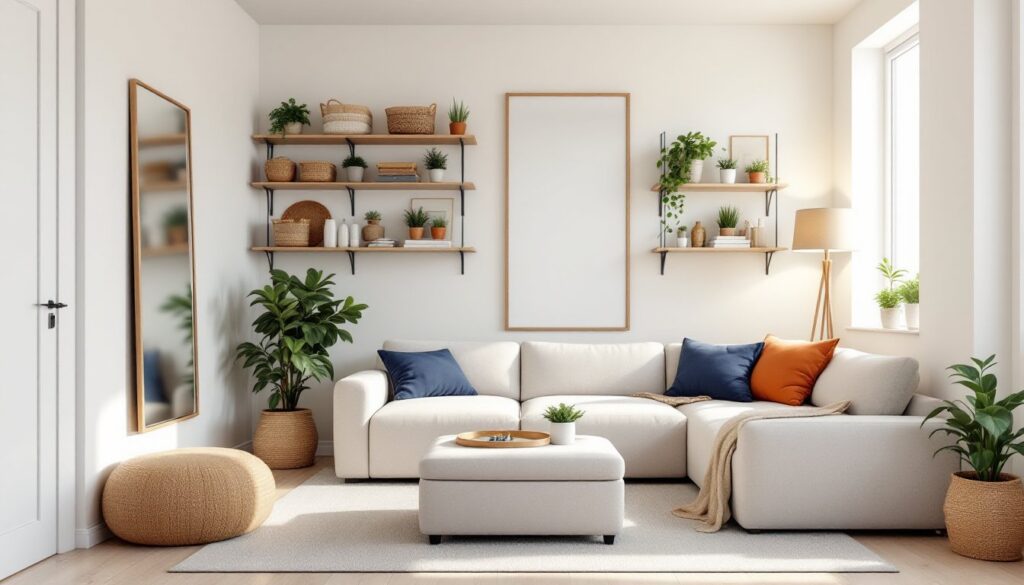
Install wall-mounted shelves above your sofa, TV area, or desk. These shouldn’t be dainty floating shelves: go for sturdy brackets rated for actual weight (check the load capacity) and space them at least 12 inches apart vertically so they don’t crowd the eye. Fill them with books, plants, small décor pieces, and baskets that hide clutter.
For items you use less often, seasonal décor, games, extra blankets, push tall cabinets or shelving all the way to the ceiling. Yes, you’ll need a step stool to reach them, but ceiling-height storage claims almost zero visual footprint compared to mid-height furniture that sits awkwardly in the room.
Pegboards and rail systems work wonders in narrow spaces. Mount one on a blank wall section to hang small storage containers, artwork, or potted plants. This adds personality without eating floor space. Hooks on adjacent walls hold throw blankets, bags, or hats while keeping them within arm’s reach.
Narrow wall-mounted consoles, just 8 to 12 inches deep, work brilliantly behind sofas or along empty walls. They provide display and storage without the bulk of a traditional sideboard. A console with drawers adds hidden storage too.
Choose Multi-Functional Furniture That Works Double Duty
Every piece of furniture in a small living room should earn its place. Sofas with built-in storage compartments under the seats or in the chaise section hide blankets, pillows, or games without adding visual clutter. When shopping, sit on the sofa and check how easily that lid or drawers open, some mechanisms get tight or noisy.
Nesting tables tuck into tight corners or stack neatly when you need more floor space. They’re perfect for small gatherings or working from home since you can pull them out as needed. Media consoles with drawers and cabinets hold remotes, cords, and AV equipment while looking intentional rather than chaotic.
Consider a sleeper sofa or quality futon if guests stay over. Modern versions don’t look or feel like the college dorm nightmare, fabric-wrapped frames and decent mattresses exist in every price range. This lets your living room transform into a guest room without eating up a second bedroom.
Ottoman Coffee Tables and Storage Benches
A lidded storage ottoman does the heavy lifting as both a coffee table and a hiding spot for blankets, board games, remotes, and throw pillows. Top it with a decorative tray to create a stable surface for drinks and small décor without losing the storage function below. Lightweight ottomans on casters let you slide them around easily when rearranging.
Storage benches work brilliantly if your living room opens to an entryway. They provide a natural spot to drop keys and bags while hiding shoes, seasonal items, or pet gear underneath. Choose one with a comfortable seat height (16 to 18 inches is standard) so it doubles as extra seating when friends visit.
Optimize Lighting to Create Depth and Dimension
Overhead lights alone make small rooms feel flat and institutional. Layer your lighting instead: ambient (general ceiling light), task (reading or working light), and accent (mood or highlighting).
Floor lamps beside or behind your sofa save precious table space while casting light where you actually use it. Position them at shoulder height when seated so they don’t create glare on screens. Wall-mounted or plug-in sconces work when table space is nonexistent, mount them flanking a small mirror or artwork to create visual interest and light without taking up real estate.
Warm-toned bulbs around 2700 to 3000 Kelvin make small spaces feel cozier and less clinical than cool white 5000K daylight bulbs. If you’re renting and can’t install hardwired sconces, peel-and-stick LED strips behind floating shelves add subtle accent lighting that transforms the room at night.
Don’t underestimate the power of a well-placed table lamp on a narrow console or shelf. It breaks up the visual weight of dark walls and adds a point of light without consuming floor space. A tripod floor lamp in one corner and a smaller desk lamp on a shelf create a balanced, layered effect.
Select a Smart Color Palette for Visual Expansion
Light, neutral walls, whites, soft grays, pale greige, make small spaces feel larger because they reflect light and don’t visually “close in” the room. This doesn’t mean your living room has to feel cold or sterile.
Limit yourself to one or two accent colors in textiles, art, and small décor pieces. A navy throw pillow, a terracotta accent chair, or a jewel-toned gallery wall adds personality without fragmenting the space visually. When eyes can rest on a cohesive background, the room feels calmer and bigger.
Keep large furniture pieces, your sofa, media console, bookshelf, in light or neutral tones. Reserve darker colors for small accents: throw pillows, artwork, a dark rug border, or a single accent wall. This creates visual hierarchy without overwhelming the space.
Consider your flooring too. Light wood or neutral carpet visually expands the floor plane. If you have darker flooring, a large light rug anchors the sitting area and creates the illusion of more space. Avoid small, bitty rugs that chop up the floor visually, a 5×7 or 6×9 rug typically works best for small living rooms.
Incorporate Mirrors and Reflective Surfaces
Mirrors are a decorating cheat code for small spaces. Position a large mirror opposite a window to bounce natural light around the room and visually “borrow” the view beyond the glass. Even on cloudy days, reflected light makes the space feel less bunker-like.
A tall mirror (4 to 5 feet) leans against a wall or hangs above a console to amplify height. Avoid placing mirrors directly behind furniture or in spots where they just reflect the sofa back at you, that defeats the purpose.
Mirrored or glass-front cabinets on your media console or shelving add reflective quality without screaming “mirror.” Glossy finishes on some décor surfaces, vases, frame mats, even a shiny throw blanket, subtly bounce light around.
A gallery of smaller mirrors in mixed frames works as both art and light amplification. Arrange them in a loose geometric pattern on one wall to create visual interest while keeping brightness bouncing. This approach works especially well if you’re drawn to interior design strategies that transform living spaces, where light and reflection play starring roles.
Mirrors also create a psychological sense of depth, when you see reflection, your brain reads it as “another room beyond,” making the actual space feel larger. This is why <a href="https://wintersummerinn.com/small-apartment-interior-design-ideas-maximize-space-and-style-in-2026/”>small apartment interior design ideas so often lean on reflective surfaces.
Conclusion
Small apartment living room decor succeeds when function and beauty work together. Stack vertical storage over bulky horizontal pieces, choose furniture that hides as much as it displays, layer your lighting warmly, stick to a calm color palette, and bounce light with mirrors and reflective surfaces. These proven strategies have transformed countless tight spaces into rooms that feel open, organized, and genuinely comfortable, proving that square footage isn’t destiny.